
All new staircases in England and Wales must comply with Approved Document K of the Building Regulations. This guide explains the key requirements in plain language.
Approved Document K — Protection from falling, collision and impact — is the part of the Building Regulations that governs staircases, balustrades, ramps, vehicle barriers, and windows in England and Wales.
The regulations apply to any new staircase, whether it is a replacement staircase in an existing home or a staircase in a new build. They are designed to ensure that stairs are safe to use by all household members — including children and older adults.
All staircases manufactured by DAB Stairs are designed and built to comply fully with the requirements of Approved Document K. Our team will advise you during the quoting process if your proposed design needs any adjustments to comply.
Diagram — Staircase Components
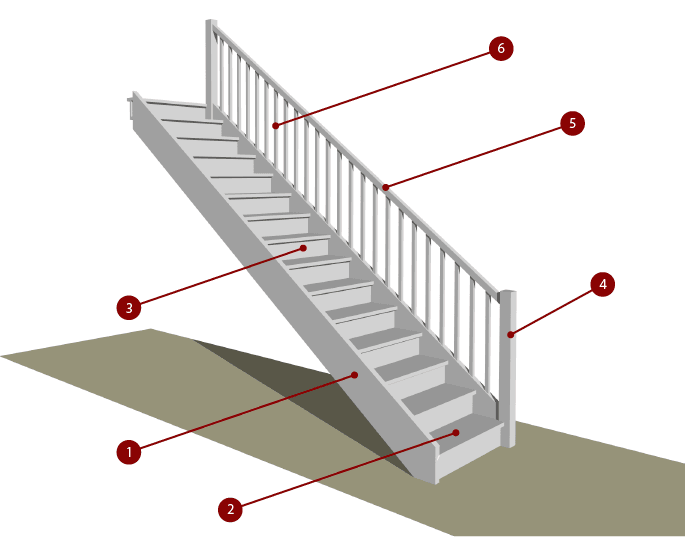
The vertical height of each individual step must be no less than 150mm and no more than 220mm.
The horizontal depth of each tread (the part you step on) must be between 220mm and 300mm.
The angle of the staircase — the steepness — must not exceed 42°. Most domestic stairs sit at 38–42°.
A minimum of 2.0 metres of clear headroom must be maintained throughout the full length of the staircase.
The rise is the vertical height of each individual step — the distance from the top of one tread to the top of the next.
Under Approved Document K, the rise must be consistent throughout the full staircase — all risers must be the same height. Inconsistent risers are a trip hazard and will fail a building regulations inspection.
The going is the horizontal depth of each individual tread — measured from the nosing of one tread to the nosing of the next.
A deeper going gives more foot room and a more comfortable staircase to walk on. Like the rise, the going must be consistent throughout — all treads the same depth.
The pitch is the angle of the staircase relative to the horizontal floor. The maximum permitted pitch under Approved Document K is 42°. In practice, most comfortable domestic staircases sit between 38° and 42°. The pitch is determined by the relationship between the rise and the going — a higher rise or shorter going will produce a steeper staircase.
Handrails must be between 900mm and 1000mm in height, measured from the pitch line (the line running along the nosings of the treads). On landings, the handrail must also be between 900mm and 1000mm.
Handrails are required on at least one side of the staircase where the width is less than 1 metre. For stairs wider than 1 metre, handrails are required on both sides.
Gaps in balustrades, railings, and spindles must not allow a 100mm sphere to pass through. This prevents young children from getting their heads trapped between spindles.
Handrails must be continuous from top to bottom and graspable — typically a round, oval, or D-profile between 40mm–50mm in diameter works well in practice.
There is no minimum width requirement specified in Approved Document K for private domestic staircases. In practice, a comfortable minimum is around 860mm clear width, though 900mm–1000mm is typical in new builds and provides comfortable access for furniture removal.
For common areas in blocks of flats and commercial buildings, a minimum clear width of 1000mm is generally required.
Winder treads are tapered treads used to change the direction of a staircase without a full landing — commonly used in quarter-turn and half-turn staircase configurations.
Under Approved Document K, the going of a winder tread is measured 270mm from the narrow end of the tread. At this point, the going must be at least 220mm and no more than 300mm — the same as a standard tread.
Winders must also have the same rise as the other treads in the staircase.
This guide provides a general summary of the requirements of Approved Document K as they apply to private domestic staircases in England and Wales. Regulations may differ in Scotland and Northern Ireland. This page does not constitute professional building control advice. Always check with your local authority building control officer or an approved inspector to confirm compliance for your specific project.
Not sure if your staircase design will comply with building regulations? Our experienced team can advise you from the very first conversation.
We use cookies and similar technologies to improve your experience on dabstairs.com. By clicking “Accept All”, you consent to the use of all cookies. You can manage your preferences or learn more by visiting our Privacy Policy.